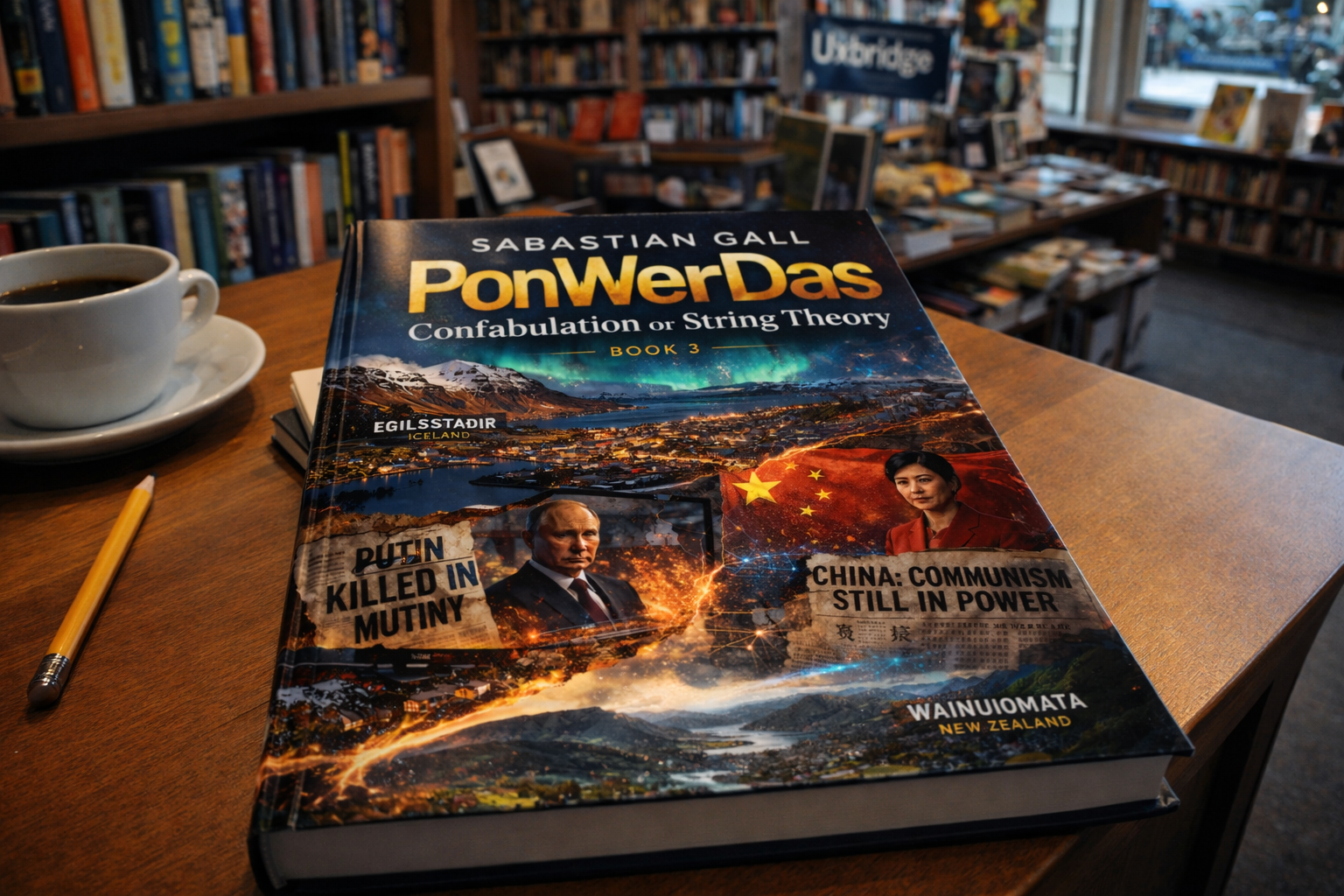
There is a particular pleasure, perhaps best understood by those of us who haunt second-hand bookshops and linger far too long in the quieter aisles of Waterstones, in discovering a novel that refuses to sit comfortably within the boundaries of genre. Sabastian Gall’s PonWerDas – Confabulation or String Theory delivers exactly that kind of experience—an unsettling, intellectually ambitious, and deeply atmospheric narrative that lingers long after the final page.
Living in Preston, where rainy afternoons practically demand philosophical fiction and a strong cup of tea, I approached this book with curiosity rather than expectation. What I encountered instead was a profoundly disquieting exploration of memory, collective belief, and the unsettling possibility that reality itself may not be as stable as we assume.
A Premise That Disturbs in the Best Possible Way
At its core, PonWerDas – Confabulation or String Theory presents a deceptively simple yet deeply unsettling idea.
In the Icelandic town of Egilsstaðir, every resident shares a vivid and unwavering memory. Back in 2023, they all watched global news reporting the death of Vladimir Putin during a rebellion led by Yevgeny Prigozhin. This is not a rumour or a vague recollection—it is a collective certainty.
Then, in 2026, everything fractures.
Television broadcasts show Putin alive and still serving as President of Russia. Outside the town, no one finds this strange.
Meanwhile, in Wainuiomata, New Zealand, another community holds a different certainty. In their shared past, communism in China collapsed in 1990. Yet they too face an impossible contradiction when reality proves otherwise.
Two towns. Two incompatible histories. One shared horror.
Gall wastes no time establishing the magnitude of this concept. The story moves beyond faulty memory and dives into something far more unsettling—the idea that reality itself may be inconsistent, and worse, selectively so.
The Quiet Horror of Certainty
Rather than relying on spectacle, Gall builds tension through restraint.
No dramatic explosions or overcomplicated scientific explanations dominate the narrative. Instead, the story leans into something far more unsettling: the quiet horror of absolute certainty.
Residents in both towns do not feel confused or uncertain. They remember clearly.
That distinction matters.
The novel circles a central question again and again: what is more frightening—being wrong, or being right in a world that insists you are not?
Gall handles this tension with precision. Characters remain rational, even as the world around them becomes irrational. Their distress comes not from confusion, but from contradiction. Reality does not simply shift—it betrays them.
Confabulation or String Theory? A Title That Demands Thought
The subtitle, Confabulation or String Theory, forms the intellectual backbone of the novel.
Confabulation refers to the mind’s ability to create false memories without intent to deceive. From this perspective, the townspeople collectively misremember events.
String theory offers a far more unsettling alternative. It suggests that multiple realities may coexist, diverge, and even overlap.
Gall refuses to choose between these explanations.
Instead, he leaves readers suspended between two equally disturbing possibilities. Either the human mind can fabricate entire histories, or reality itself shifts in ways only some can perceive.
Both ideas unsettle. Together, they become deeply disturbing.
A Study in Collective Memory
One of the novel’s most compelling elements lies in its treatment of shared memory.
In Egilsstaðir, residents reinforce their belief through conversation and mutual recognition. Agreement strengthens their certainty. The same pattern unfolds in Wainuiomata.
This dynamic raises a powerful question: if an entire community remembers something, does that make it any less real?
Gall suggests that memory operates not only on a personal level, but also a social one. People construct and validate memories together. When that shared foundation breaks, confusion turns into existential dread.
Isolation as a Narrative Device
The settings play a crucial role in shaping the story.
Both Egilsstaðir and Wainuiomata exist far from major centres of power and information. Their relative isolation heightens the tension.
Characters cannot easily verify their experiences. News broadcasts, online sources, and official statements all contradict them. Every external source reinforces a version of reality they know to be wrong.
This creates a suffocating sense of claustrophobia.
At the same time, Gall uses isolation to explore how communities process shared trauma. Unity initially strengthens the towns, but cracks begin to appear. Individuals respond differently to the same impossible situation.
Some search for answers. Others retreat into denial. A few begin to question themselves.
Characters as Anchors in an Unstable World
Despite its high-concept premise, the novel remains grounded in human experience.
Gall focuses on a select group of characters rather than overwhelming the reader with a large cast. Teachers, shopkeepers, and journalists take centre stage. These ordinary individuals face extraordinary circumstances.
Their reactions feel authentic.
One of the most striking aspects of the story involves the gradual erosion of trust. Characters begin by questioning institutions and media. Eventually, they turn inward and question their own minds.
This psychological unraveling gives the novel its emotional depth.
The Role of Media and Authority
Gall’s portrayal of media feels especially relevant in today’s world.
Television reports and official narratives present a consistent version of reality. That version directly contradicts the lived experiences of the townspeople. No acknowledgement of discrepancy exists.
As a result, anyone who challenges the dominant narrative appears delusional.
Gall avoids heavy-handed commentary, yet the implications remain clear. Powerful institutions shape accepted reality. Those who experience something different struggle to be believed.
Truth becomes a matter of consensus rather than fact.
A Slow-Burning Narrative That Rewards Patience
The pacing may surprise readers expecting a fast-moving thriller.
Gall builds tension gradually. Unease seeps into the narrative rather than arriving in dramatic bursts. This approach mirrors the characters’ experience, making the story feel more immersive.
Moments of revelation remain subtle. Instead of providing clear answers, they raise further questions.
For readers who enjoy philosophical fiction, this slow burn proves deeply satisfying.
Language and Style: Elegant and Unsettling
Gall writes with precision and restraint.
He avoids excessive metaphor while maintaining a strong atmospheric presence. Everyday moments—watching television, walking through town, casual conversations—carry a quiet sense of unease.
The familiar begins to feel slightly wrong.
This subtle distortion reinforces the novel’s core idea. Reality does not need dramatic alteration to become unsettling. A single contradiction can be enough.
Philosophical Depth Without Pretension
Complex ideas run throughout the novel, yet Gall presents them accessibly.
Questions about memory, perception, and reality emerge naturally through character experiences. The narrative never feels overly academic or detached.
Readers do not need specialised knowledge to engage with the story. Curiosity and an openness to uncertainty are enough.
The Emotional Core: Fear of Isolation
At its heart, the novel tells an emotional story.
The most unsettling aspect does not lie in shifting realities, but in isolation. Characters face the terrifying possibility of being alone in their truth.
Remembering something that no one else recalls creates deep unease. Insisting on that memory invites rejection. Doubting oneself becomes inevitable.
Gall captures this progression with empathy and precision.
A Novel That Lingers
Even after finishing the book, its questions remain.
What happens if reality changes—just for you? Would you trust your memory or the world around you? At what point would doubt take over?
These questions offer no easy answers.
Final Thoughts
PonWerDas – Confabulation or String Theory does not aim to entertain in a conventional sense. Instead, it challenges, unsettles, and provokes thought.
Readers who appreciate speculative fiction with philosophical depth will find it rewarding. Those seeking clear resolutions may feel unsettled by its ambiguity.
That ambiguity, however, defines the novel’s strength.
In a world shaped by competing narratives and uncertain truths, Gall’s work feels timely and necessary. It reminds us that reality may be far more fragile than we believe.
Once doubt takes hold, letting go becomes nearly impossible.
Verdict
A deeply intelligent and quietly disturbing novel that explores memory, identity, and the instability of reality.
Rating: ★★★★½ (4.5/5)