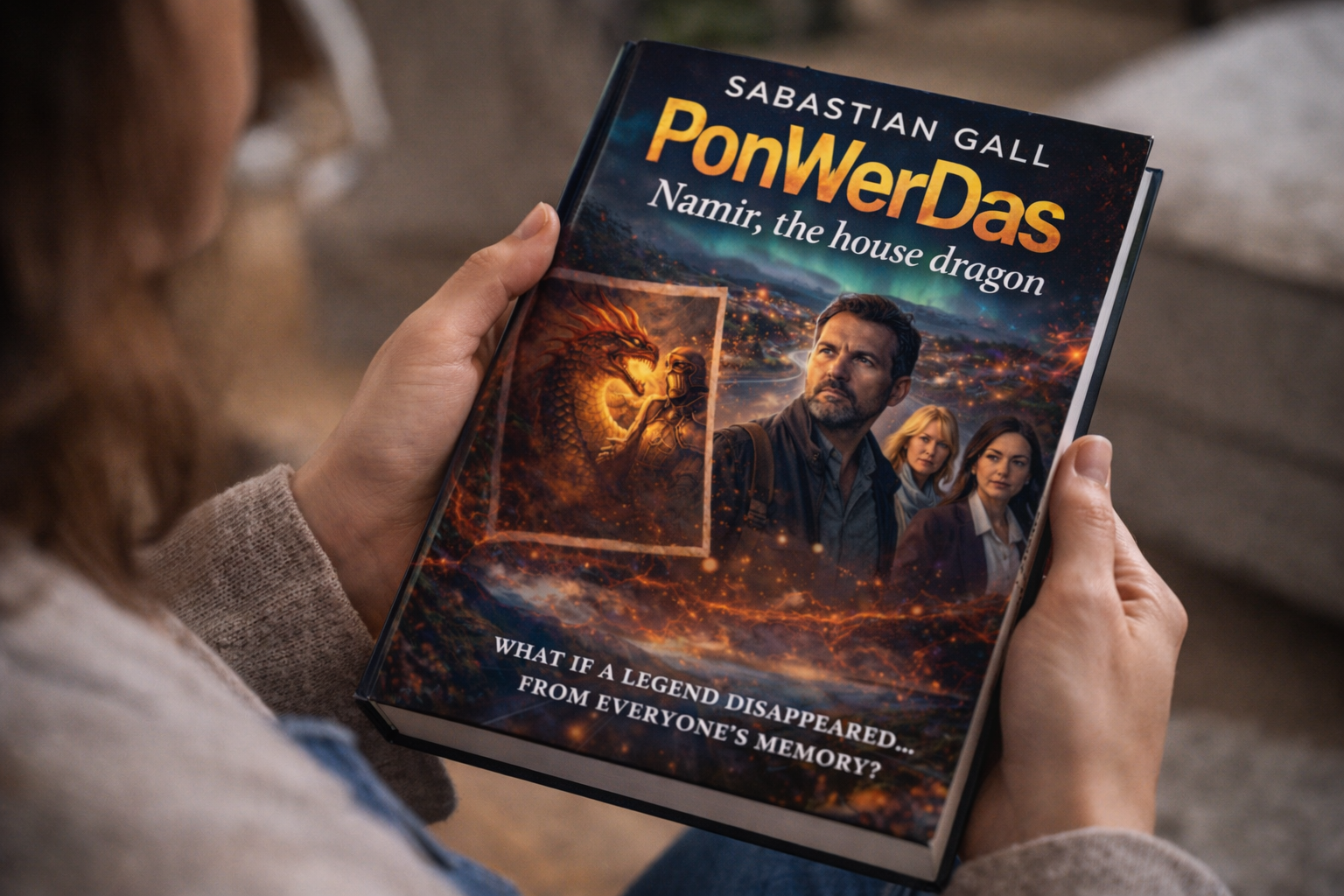
There are stories you read, stories you remember, and then—rarely—stories that seem to read you back. PonWerDas – Namír, the House Dragon, the fourth installment in the ambitious PonWerDas series by Sabastian Gall, firmly belongs in that last category. It is not merely a continuation of a narrative arc; it is an intellectual and emotional experiment that interrogates memory, fiction, and reality itself.
Gall’s work here transcends traditional genre boundaries. At its surface, it is speculative fiction rooted in multiverse theory. Beneath that, however, lies a philosophical meditation on cultural memory, storytelling as a shared human construct, and the fragility of existence when the stories that define us vanish without warning.
This is not a casual read. It demands attention, rewards patience, and lingers long after the final page.
A Premise That Unsettles the Reader
“What happens when a story… simply disappears from the world?”
That question alone is enough to anchor the novel in existential unease. Gall wastes no time in establishing a deeply unsettling premise: Namír, the House Dragon—a fictional cultural cornerstone beloved across generations—has been erased from collective memory.
Not forgotten. Not ignored. Erased.
This distinction is critical, and Gall understands it. Forgetting implies decay; erasure implies intervention.
The story follows Pedro Suarez, a theatre director preparing an adaptation of this legendary tale. When a strange celestial phenomenon interrupts his journey—a cascade of orange lights followed by a blinding flash—reality fractures. The next day, the impossible becomes undeniable: the world has no recollection of the story that once defined it.
Except for Pedro—and a small handful of others.
This narrative hook is both elegant and deeply disorienting. It taps into a universal fear: not death, but the loss of meaning. If a story that shaped entire generations can vanish, what does that say about the stability of reality itself?
Narrative Craftsmanship: Precision Meets Imagination
Gall’s writing style in this instalment is markedly refined. Compared to earlier entries in the PonWerDas series, Namír, the House Dragon exhibits tighter pacing, more deliberate structural choices, and a clearer thematic focus.
The narrative unfolds in layers:
- The Immediate Mystery – What happened to the story?
- The Psychological Impact – How do characters react to being the only ones who remember?
- The Cosmic Implication – What does this event reveal about the nature of reality?
Each layer feeds into the next, creating a reading experience that is both immersive and intellectually stimulating.
Gall avoids exposition-heavy passages—a common pitfall in multiverse fiction—and instead reveals information organically through dialogue, memory fragments, and subtle environmental shifts. The result is a story that feels alive, constantly evolving, and slightly out of reach.
Pedro Suarez: A Protagonist Anchored in Reality
Pedro Suarez is an inspired choice for a protagonist. As a theatre director, he exists at the intersection of storytelling and reality—a man whose profession revolves around interpreting fiction for an audience.
This makes him uniquely suited to confront a world where fiction has been erased.
Pedro is not a traditional hero. He does not possess extraordinary abilities or hidden powers. His strength lies in his perception, his memory, and his refusal to accept the absurdity of his situation as normal.
Gall portrays Pedro with remarkable nuance:
- He begins with disbelief, even humour.
- He transitions into confusion and quiet dread.
- Eventually, he confronts the terrifying possibility that reality itself is mutable.
What makes Pedro compelling is his humanity. His reactions feel authentic, grounded, and relatable—even as the world around him becomes increasingly surreal.
The Supporting Cast: Echoes of a Lost World
While Pedro is the narrative anchor, the supporting characters serve as emotional and thematic mirrors.
His wife and assistant—two of the few who retain memory of the erased story—represent different responses to the same phenomenon:
- Acceptance vs Resistance
- Fear vs Curiosity
- Preservation vs Adaptation
Gustavo, the friend who unknowingly triggers Pedro’s realisation, is particularly effective despite limited screen time. His confusion is genuine, and through him, the reader experiences the first true rupture in reality.
Gall uses these characters not just as companions, but as instruments to explore how individuals process the collapse of shared truth.
The Multiverse: Not Just a Concept, but a Threat
Multiverse storytelling has become increasingly common, but Gall approaches it with a refreshing level of restraint and originality.
In Namír, the House Dragon, the multiverse is not a playground—it is a destabilising force.
The disappearance of the story is not presented as a random anomaly. Instead, it hints at:
- Overlapping realities
- Divergent timelines
- The possibility that stories themselves exist across dimensions
Gall raises a profound question: What if stories are not created, but discovered?
If Namír exists in one reality but not another, what happens when those realities intersect? Does one overwrite the other? Do they merge? Or do they annihilate each other?
These ideas are never fully explained—and that is precisely their strength. Gall trusts the reader to engage with the ambiguity.
Memory as a Narrative Weapon
One of the novel’s most powerful themes is the role of memory in shaping reality.
In most fiction, memory is a passive element—a record of what has happened. In this story, memory becomes active, almost combative.
Those who remember Namír are not just witnesses; they are anomalies.
Gall explores this concept with precision:
- Memory becomes isolation.
- Knowledge becomes burden.
- Awareness becomes danger.
The idea that remembering something others cannot is inherently destabilising is deeply unsettling. It turns a fundamental human function into a source of fear.
The Meta-Literary Dimension
Perhaps the most fascinating aspect of Namír, the House Dragon is its meta-literary layer.
Gall is not just telling a story—he is commenting on storytelling itself.
The fictional tale of Namír is described as:
- A cultural phenomenon
- A multi-generational narrative
- A story adapted across mediums
In essence, it mirrors the real-world impact of beloved literary franchises.
By erasing this fictional cornerstone, Gall invites readers to consider:
- What defines a “classic”?
- How do stories become embedded in cultural identity?
- What happens when those stories are removed?
It is a bold narrative choice, and it pays off. The reader becomes acutely aware of their own relationship with stories—both fictional and real.
Atmosphere: Quiet Dread Over Spectacle
Despite its high-concept premise, Namír, the House Dragon is remarkably restrained in its execution.
There are no explosive action sequences or grandiose set pieces dominating the narrative. Instead, Gall opts for a slow-burning atmosphere of unease.
Key moments are subtle:
- A conversation that doesn’t align with memory
- A poster that no longer holds meaning
- A world that feels slightly… off
This approach is far more effective than overt spectacle. It creates a persistent sense of tension that never fully dissipates.
The horror here is not visual—it is conceptual.
Pacing: A Controlled Descent
The pacing of the novel deserves particular praise.
Gall structures the story as a gradual descent rather than a rapid escalation. Each revelation builds upon the last, creating a sense of inevitability.
The first third establishes the mystery.
The second deepens the implications.
The final act confronts the consequences.
This progression feels natural, almost inevitable, and it ensures that the reader remains engaged throughout.
Language and Style: Clean, Precise, Effective
Gall’s prose is clean and purposeful. There is little excess, no unnecessary ornamentation.
This minimalist approach works in the novel’s favour:
- It enhances readability
- It maintains narrative momentum
- It allows the concepts to take centre stage
The dialogue is particularly strong—natural, believable, and often layered with subtext.
Gall knows when to explain and, more importantly, when not to.
Themes That Resonate
At its core, Namír, the House Dragon is about more than multiverses. It explores several deeply resonant themes:
1. The Fragility of Reality
Reality, as presented in the novel, is not fixed. It is subject to change, distortion, and erasure.
2. The Power of Stories
Stories are not just entertainment—they are foundational to identity and culture.
3. Isolation Through Knowledge
Knowing something others do not can be as isolating as it is empowering.
4. The Fear of Being Forgotten
Not personal death, but cultural disappearance—the loss of meaning beyond existence.
A Worthy Fourth Entry in the PonWerDas Series
As the fourth book in the PonWerDas series, Namír, the House Dragon demonstrates significant evolution in Gall’s storytelling.
It builds upon the conceptual groundwork of earlier instalments while introducing new layers of complexity.
Importantly, it does not rely heavily on prior knowledge. While returning readers will appreciate the continuity, newcomers can engage with the story on its own terms.
Final Verdict: A Thought-Provoking Masterpiece
PonWerDas – Namír, the House Dragon is not just a novel—it is an experience.
It challenges the reader to question:
- What is real?
- What is remembered?
- And what happens when those two no longer align?
Sabastian Gall has crafted a story that is both intellectually stimulating and emotionally resonant. It is a rare blend of speculative fiction and philosophical inquiry, executed with precision and confidence.
This is a book that does not provide easy answers—and it is all the better for it.
Who Should Read This Book?
This novel is ideal for readers who enjoy:
- High-concept speculative fiction
- Multiverse narratives with depth
- Psychological and philosophical storytelling
- Stories that challenge perception and reality
It may not appeal to those seeking fast-paced, action-driven plots. But for readers willing to engage with its ideas, it offers a deeply rewarding experience.
Closing Thoughts
In a literary landscape saturated with predictable narratives, Namír, the House Dragon stands apart.
It dares to ask difficult questions.
It refuses to simplify complex ideas.
And most importantly, it trusts the reader to think.
If stories shape our understanding of the world, then this one reshapes how we understand stories themselves.
And once you’ve read it, one question will linger:
If a story can disappear… what else might already be gone?