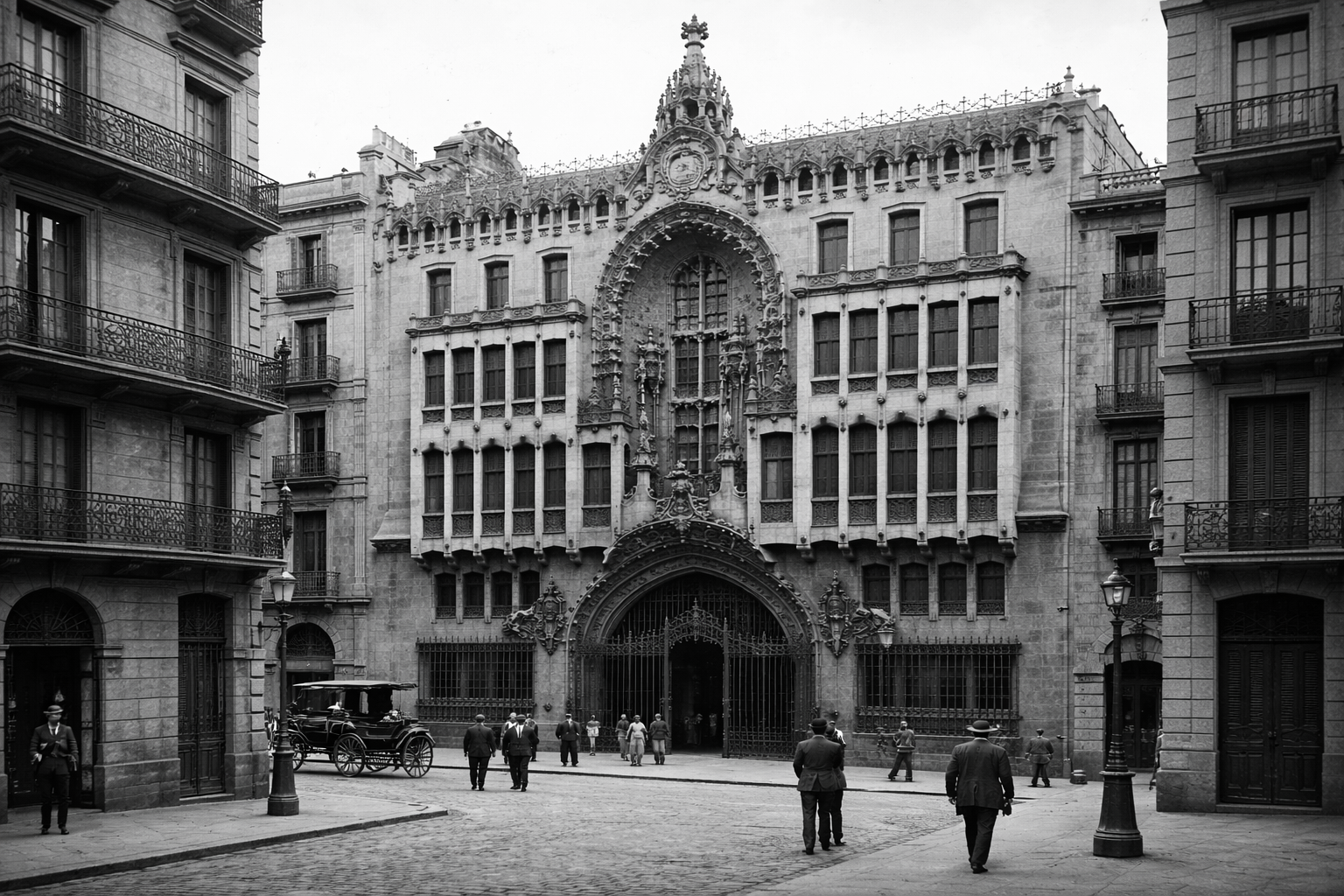
Sabastian Gall’s Barcelona – Republic of a Kingdom is the kind of historical novel that quietly settles into your mind and then refuses to leave. It does not rely on spectacle alone, though spectacle is certainly present. Instead, it draws its strength from atmosphere, from the steady layering of voices, and from its ability to capture a city at a moment when everything seems possible—and everything is at risk.
Set between 1888 and 1895, the novel opens with a scene that feels almost cinematic in its scale. Barcelona is alive with anticipation as the World’s Fair begins. The Arc de Triomf stands as both symbol and stage, a gateway into a future that promises progress, innovation, and cultural renewal. Flags wave, music fills the air, and the crowd gathers in celebration. At the centre of it all is Mayor Francesc de Paula Rius i Taulet, whose vision and ambition drive the transformation of the city.
From the outset, Gall establishes a key tension: the contrast between outward celebration and the undercurrent of unease beneath it. This is not merely a story about a city’s rise; it is about the fragile foundations upon which that rise is built.
A City as the True Protagonist
One of the most striking aspects of Barcelona – Republic of a Kingdom is how the city itself becomes the central character. Gall does not treat Barcelona as a static backdrop. Instead, it breathes, evolves, and reacts to the ambitions and fears of those who inhabit it.
Through richly detailed descriptions, readers are transported into bustling streets, newly constructed avenues, and shadowed alleyways where conversations take place in hushed tones. The juxtaposition of grand architectural projects with the everyday struggles of ordinary citizens creates a layered narrative that feels both intimate and expansive.
Gall’s Barcelona is a place of contradictions. It is a city of light and shadow, of innovation and unrest, of beauty and inequality. This duality runs through every chapter, reinforcing the novel’s central question: what does progress truly mean, and who pays the price for it?
Historical Figures Brought to Life
The novel excels in its portrayal of real historical figures, each of whom embodies a different facet of Barcelona’s transformation.
Antoni Gaudí emerges as a fascinating presence—an artist driven not by convention but by an almost spiritual pursuit of form. Gall captures his eccentricity without reducing him to caricature. Instead, Gaudí becomes a symbol of creative freedom, someone who sees possibilities where others see limits.
Eusebi Güell, the industrialist, represents another dimension of progress. His vision is rooted in economic growth and influence, yet Gall carefully reveals the moral complexities behind his ambitions. Güell understands that every step forward carries consequences, and this awareness adds depth to his character.
Lluís Domènech i Montaner brings a sense of intellectual and cultural identity to the narrative. Through him, the novel explores ideas of nationalism and the role of art in shaping collective consciousness. His voice contrasts with the more pragmatic concerns of political and industrial leaders, offering a broader perspective on what Barcelona could become.
Narcís Oller, meanwhile, serves as a quiet observer. His role is particularly compelling because he bridges the gap between participant and witness. Through his eyes, readers gain insight into the unfolding events, as well as the subtle shifts in mood that might otherwise go unnoticed.
Gall handles these figures with care, ensuring that they feel human rather than symbolic. Their ambitions, doubts, and interactions create a dynamic interplay that enriches the narrative.
The Power of Fictional Voices
While the historical figures provide structure, it is the fictional characters who give the novel its emotional core. Gall introduces several everyday individuals whose lives intersect with the larger events of the time. Through them, the reader experiences the impact of political decisions and social changes on a personal level.
Among these characters, the anarchist couple Pedro and Alejandra stand out as the most compelling. Their relationship is both tender and volatile, shaped by love as well as ideology. They are not merely romantic figures; they are deeply embedded in the social tensions of the era.
Pedro’s passion for justice and Alejandra’s fierce independence create a dynamic that feels authentic and, at times, heartbreaking. Their love is not separate from the world around them—it is influenced by it, tested by it, and ultimately threatened by it.
Gall uses their story to explore themes of belief and sacrifice. What does it mean to fight for a cause? How much can one give before losing oneself? These questions are woven into their journey, making their narrative both intimate and universal.
The Weight of Progress
At its heart, Barcelona – Republic of a Kingdom is a meditation on progress. The World’s Fair serves as a powerful symbol of advancement, showcasing technological achievements and cultural aspirations. Yet Gall consistently reminds readers that progress is not a neutral force.
The novel highlights the disparities that accompany development. As new buildings rise and industries expand, not everyone benefits equally. Workers face difficult conditions, strikes become more frequent, and tensions simmer beneath the surface.
Gall does not present these issues in a simplistic manner. Instead, he allows them to unfold gradually, mirroring the slow build-up of pressure within the city. This approach makes the eventual conflicts feel inevitable rather than abrupt.
The theme of progress is also explored through personal choices. Characters are forced to confront the consequences of their actions, whether they are political leaders making decisions for the city or individuals navigating their own paths.
Narrative Style and Structure
Gall’s writing style is both elegant and accessible. He strikes a balance between descriptive richness and narrative momentum, ensuring that the story never feels weighed down by detail.
The structure of the novel reflects its thematic complexity. Multiple perspectives are interwoven, allowing readers to see events from different angles. This technique enhances the sense of depth, as each character’s viewpoint adds another layer to the narrative.
Transitions between scenes are handled with care, often linking disparate storylines through shared themes or subtle connections. This creates a cohesive reading experience, even as the scope of the novel expands.
Dialogue is another strength. Conversations feel natural and purposeful, revealing character traits while advancing the plot. Gall avoids unnecessary exposition, trusting readers to piece together information through context.
Atmosphere and Mood
One of the most memorable aspects of the novel is its atmosphere. Gall has a keen sense of mood, and he uses it to great effect.
The early chapters are filled with optimism and excitement, reflecting the spirit of the World’s Fair. There is a sense of possibility, of a city on the brink of greatness. However, this mood gradually shifts as the story progresses.
Tension builds slowly but steadily. Moments of celebration are overshadowed by hints of unrest. Secret meetings, whispered conversations, and growing dissatisfaction create an undercurrent of unease.
By the later stages of the novel, this tension becomes more pronounced. The contrast between the city’s outward appearance and its internal struggles reaches a peak, leading to a series of events that feel both dramatic and inevitable.
Themes of Identity and Belonging
In addition to its exploration of progress, the novel delves into questions of identity and belonging. Barcelona is not just a physical space; it is a cultural and emotional landscape.
Through characters like Domènech i Montaner, Gall examines the idea of national identity and the role of art in expressing it. At the same time, the experiences of ordinary citizens highlight the complexities of belonging in a rapidly changing society.
For Pedro and Alejandra, identity is tied to their beliefs and their relationship. Their struggle reflects a broader tension between individual desires and collective ideals.
This theme resonates throughout the novel, reminding readers that progress is not only about infrastructure and innovation—it is also about people and their sense of place in the world.
Emotional Impact
What sets Barcelona – Republic of a Kingdom apart from many historical novels is its emotional depth. Gall does not rely on dramatic events alone to engage readers. Instead, he focuses on the internal experiences of his characters.
Moments of quiet reflection are given as much importance as moments of action. This allows readers to connect with the characters on a deeper level, understanding not just what they do but why they do it.
The relationship between Pedro and Alejandra is particularly effective in this regard. Their love story is not idealised; it is complex, shaped by external pressures and internal conflicts. This realism makes their journey all the more compelling.
A Thought-Provoking Conclusion
As the novel moves towards its conclusion, the various threads come together in a way that feels both satisfying and thought-provoking. Gall does not offer easy answers. Instead, he leaves readers with questions that linger long after the final page.
What is progress worth if it comes at the cost of humanity? Can a city truly move forward without leaving parts of itself behind? These are not questions confined to the past—they remain relevant today.
Final Thoughts
Barcelona – Republic of a Kingdom is a remarkable achievement. It combines meticulous historical detail with compelling storytelling, creating a novel that is both informative and engaging.
Sabastian Gall has crafted a narrative that captures the spirit of a transformative period while also exploring timeless themes. The result is a book that appeals to both history enthusiasts and general readers.
For those who appreciate historical fiction that goes beyond surface-level storytelling, this novel offers a rich and rewarding experience. It invites readers to immerse themselves in a world that feels vividly real, while also encouraging them to reflect on the broader implications of progress.
In the end, Barcelona – Republic of a Kingdom is not just a story about a city. It is a story about people, choices, and the delicate balance between ambition and humanity. It is a novel that stays with you, prompting you to look at both the past and the present with new eyes.