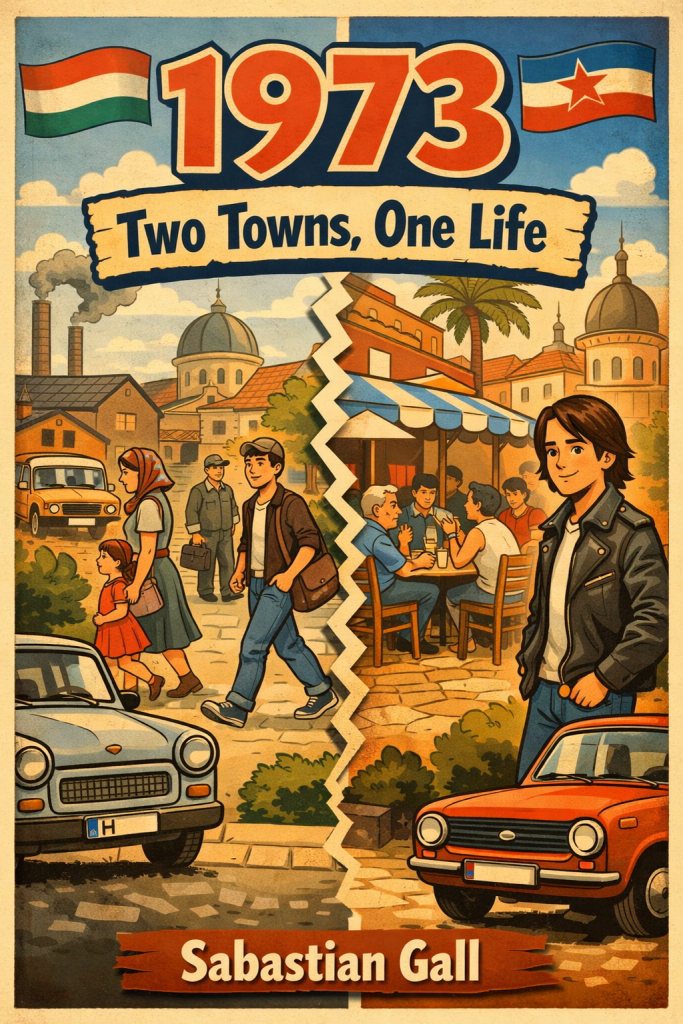
Summer, 1973.
Two small towns, only a few hundred kilometers apart.
Two families who never meet — yet live the same life.
In Jászberény, the days of the Botka family unfold in a predictable rhythm.
The father works at a factory, the mother in an office, the grandmother quietly holds on to memories of a different past. The rules are clear, the paths are set — and they rarely lead far.
In Óbecse, the life of the Csábrádi family is just as simple, yet more open.
They linger longer in cafés, conversations are louder, and the world — even if not easily — feels closer. A relative sends packages from Germany, someone is preparing to leave for Austria, and Western music drifts in through open windows.
Both families live with the same questions:
- What does an old person do with their past in a new world?
- How long can one live safely without taking risks?
- And what kind of future can a young person choose when the whole world seems bounded by invisible borders?
Bertalan Botka learns to adapt.
Csongor Csábrádi wants to escape.
Bernadett Botka dreams.
Csilla Csábrádi already understands that dreams come with a price.
As small, everyday moments — standing in line at a shop, a family dinner, a summer evening in the town square — begin to mirror each other, a quiet truth emerges:
the same life can feel very different depending on how freely it can be lived.
This is not a story about systems.
It is a story about people — living in the same time,
but not in the same world.