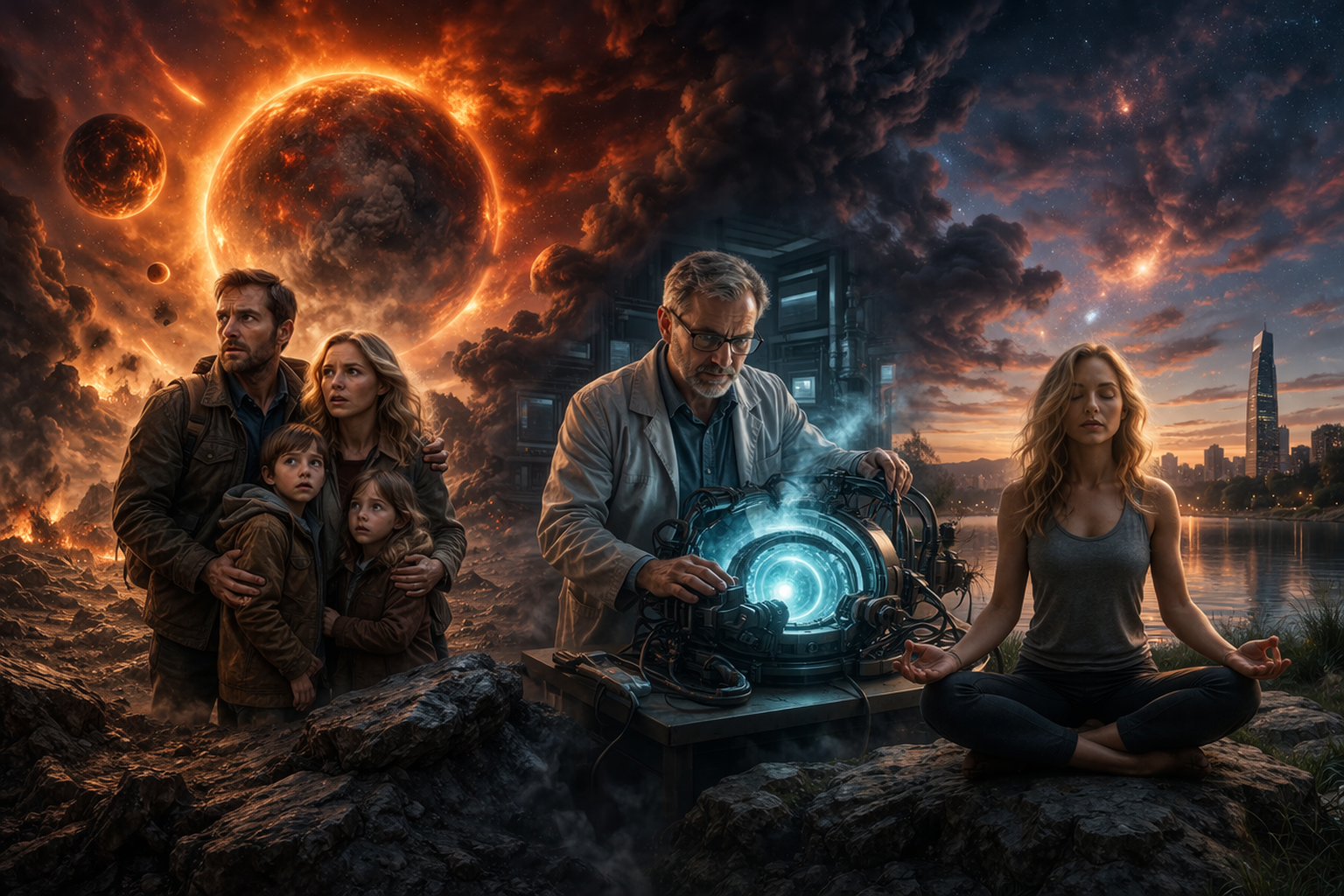
In an era where multiverse storytelling risks becoming formulaic, PonWerDas – Children of the Sun by Sabastian Gall arrives as a refreshing, ambitious, and deeply unsettling narrative. This is not just another parallel universe tale filled with alternate selves and speculative science. Instead, Gall crafts a layered story that blends theoretical physics, existential dread, and intimate human struggle into a sweeping narrative about survival across collapsing realities.
This early review explores a story that feels both intellectually daring and emotionally grounded—a rare combination in modern science fiction.
A Story Built on Defiance
At the heart of Children of the Sun lies a provocative idea: what if the boundaries between universes are not fixed, but fragile?
The novel opens with Professor Fristi Fud, a veteran theoretical physicist working at CERN. He is not portrayed as a stereotypical eccentric genius. Instead, Gall writes him as a disciplined, deeply respected scientist whose radical ideas place him at odds with mainstream physics.
Most scientists accept the possibility of parallel universes, but they treat them as isolated systems—real, yet unreachable. Fristi rejects that limitation entirely.
His theory is both elegant and dangerous: universes are not separate—they interact, overlap, and may even bleed into each other. They are born and destroyed in a constant cycle, and the walls dividing them are thinner than humanity dares to believe.
This premise immediately sets the tone for the novel. Gall is not interested in safe speculation. He pushes into territory that questions the stability of reality itself.
The Machine That Should Not Exist
Fristi’s work culminates in the creation of a device designed to generate negative energy—an idea rooted in real theoretical physics but pushed into fictional extremes. The goal is to open a wormhole between universes.
This is where the narrative begins to shift from intellectual curiosity to quiet dread.
Gall handles the scientific elements with notable restraint. He avoids overwhelming the reader with jargon, instead focusing on the implications of the experiment. The machine is not simply a tool; it represents humanity’s refusal to accept limits.
And that refusal carries consequences.
What makes this storyline particularly compelling is how subtly the danger is introduced. There is no immediate catastrophe, no dramatic explosion. Instead, a creeping sense of unease builds as Fristi begins to suspect that his discovery is not revealing new worlds—but exposing something that should have remained hidden.
A Family in Flight from Oblivion
Running parallel to Fristi’s story is one of the novel’s most emotionally powerful threads: the journey of Charlie Chase and his family.
Unlike the controlled environment of a research facility, Charlie’s world is defined by chaos and constant movement. He, his wife Emma, and their twin children are not explorers—they are survivors.
They are fleeing something they call the Fade.
The Fade is one of the most striking concepts in the novel. It appears as glowing orange patches in the sky, at first almost beautiful, then increasingly ominous. These patches expand slowly, consuming entire landscapes, then entire planets, until nothing remains.
And when the sky is fully consumed, the universe simply ceases to exist.
Gall’s depiction of the Fade is chilling precisely because of its simplicity. There are no monsters, no dramatic battles—only an unstoppable force that erases reality itself.
Charlie’s ability to glimpse fragments of the future adds a layer of tension to every decision. His visions are not precise enough to offer certainty, only enough to suggest where danger will appear next. This creates a constant sense of urgency, as the family must decide when to abandon one world and risk jumping into another.
Emma’s ability is even more extraordinary—and more unsettling. She can transfer their consciousness into alternate versions of themselves in another universe. This allows them to escape destruction, but it raises profound questions about identity.
Are they still themselves, or merely replacements?
Gall does not provide easy answers, and that ambiguity becomes one of the novel’s strongest themes.
Survival at a Cost
What elevates this storyline beyond a typical survival narrative is its emotional depth.
The family’s journey is not just about escaping the Fade—it is about enduring the psychological toll of endless displacement. Each new world offers temporary safety, but no permanence. Friendships cannot last. Homes cannot be built. Stability is an illusion.
The children, in particular, become a focal point for the story’s emotional weight. Through them, Gall explores the long-term consequences of living without a fixed reality. Their understanding of identity, belonging, and even memory begins to shift.
This is where the novel excels. It uses high-concept science fiction to explore deeply human concerns—fear, loss, and the search for meaning in an unstable universe.
Dreams That Refuse to Stay Dreams
The third major narrative thread introduces Katarina Kjellström, a yoga instructor living in Malmö. Her life initially appears disconnected from the cosmic scale of the other storylines.
Yet Katarina may be the novel’s most intriguing character.
Since childhood, she has experienced vivid dreams of other lives—alternate versions of herself existing in different realities. These dreams are not symbolic or abstract. They feel real, as though her consciousness briefly crosses into other universes.
For most of her life, she dismisses them.
That changes when she dreams of the orange glow of the Fade.
This moment marks a turning point in the novel. Katarina becomes the bridge between worlds—not through technology or survival instincts, but through perception. She sees what others cannot.
Her attempts to warn those around her are met with skepticism, reinforcing one of the book’s recurring themes: truth is often indistinguishable from madness when it challenges accepted reality.
Gall portrays Katarina with a quiet intensity. She is neither a traditional hero nor a passive observer. Instead, she embodies the tension between intuition and rationality.
Three Stories, One Convergence
For much of the novel, these three narratives unfold independently. Each has its own tone, pacing, and thematic focus.
Fristi’s story is intellectual and suspenseful.
Charlie’s is urgent and emotionally charged.
Katarina’s is introspective and increasingly surreal.
The brilliance of Gall’s structure lies in how these threads gradually begin to align.
Small details start to overlap. Concepts introduced in one storyline echo in another. The Fade, initially confined to Charlie’s reality, begins to appear in Katarina’s visions. Fristi’s research hints at forces that may explain—or worsen—the phenomenon.
By the time the narratives converge, the reader has already begun to sense the connection.
And when it happens, it feels both inevitable and deeply unsettling.
The Fade as a Cosmic Metaphor
Beyond its role as a plot device, the Fade functions as a powerful metaphor.
It represents entropy, decay, and the fragility of existence. But more importantly, it raises a fundamental question: what happens when reality itself is no longer reliable?
Gall does not present the Fade as an enemy that can be defeated. It is not a villain with motives or weaknesses. It simply exists, spreading from one universe to another with no clear origin.
This lack of explanation is deliberate—and effective.
In a genre often driven by solutions, Children of the Sun embraces uncertainty. The Fade cannot be easily understood, and that makes it far more terrifying.
Scientific Ideas Without the Weight
One of the novel’s greatest strengths is its ability to engage with complex scientific concepts without becoming inaccessible.
Gall clearly draws inspiration from real theories in physics—multiverse models, wormholes, negative energy—but he never allows the science to overshadow the story.
Instead, the focus remains on consequences.
What happens when humans gain the ability to interact with other universes?
What are the ethical implications of inhabiting alternate versions of ourselves?
Can knowledge itself become dangerous?
These questions drive the narrative forward, making the science feel relevant rather than ornamental.
Atmosphere and Tone
The tone of Children of the Sun is consistently tense, but never overwhelming.
Gall balances moments of high-stakes urgency with quieter, reflective scenes. This pacing allows the reader to absorb the emotional and philosophical weight of the story.
The atmosphere shifts seamlessly between sterile laboratories, collapsing worlds, and dreamlike visions. Each setting feels distinct, yet connected by an underlying sense of instability.
There is a persistent feeling that something is wrong—not just within the story, but within reality itself.
Character Depth and Human Connection
Despite its expansive scope, the novel remains deeply character-driven.
Fristi is defined by his refusal to accept limits, but also by the consequences of that defiance. His story raises questions about ambition and responsibility.
Charlie and Emma represent resilience, but also the cost of survival. Their relationship is tested not by conflict between them, but by the relentless pressure of their circumstances.
Katarina embodies curiosity and intuition, challenging the boundaries between science and perception.
Each character brings a different perspective to the central themes, enriching the narrative without fragmenting it.
A Narrative That Builds Rather Than Explains
One of the most striking aspects of Gall’s writing is his restraint.
He resists the urge to over-explain. Instead, he allows the story to unfold gradually, trusting the reader to piece together the connections.
This approach creates a sense of discovery, but also unease. The lack of clear answers mirrors the uncertainty faced by the characters.
It is a risky choice, but one that pays off.
Final Thoughts
PonWerDas – Children of the Sun is a bold and thought-provoking addition to contemporary science fiction. It combines high-concept ideas with emotional depth, creating a story that is both intellectually engaging and deeply human.
Sabastian Gall demonstrates a clear understanding of the genre’s potential—not just as a vehicle for imaginative worlds, but as a means of exploring fundamental questions about existence, identity, and the limits of knowledge.
This is not a story that offers comfort or easy answers. Instead, it challenges the reader to confront the possibility that reality itself may be far more fragile than we believe.
And that is precisely what makes it so compelling.
For readers seeking a science fiction novel that dares to go beyond familiar tropes, Children of the Sun is a journey worth taking—just be prepared for the unsettling realization that some boundaries, once crossed, can never be restored.