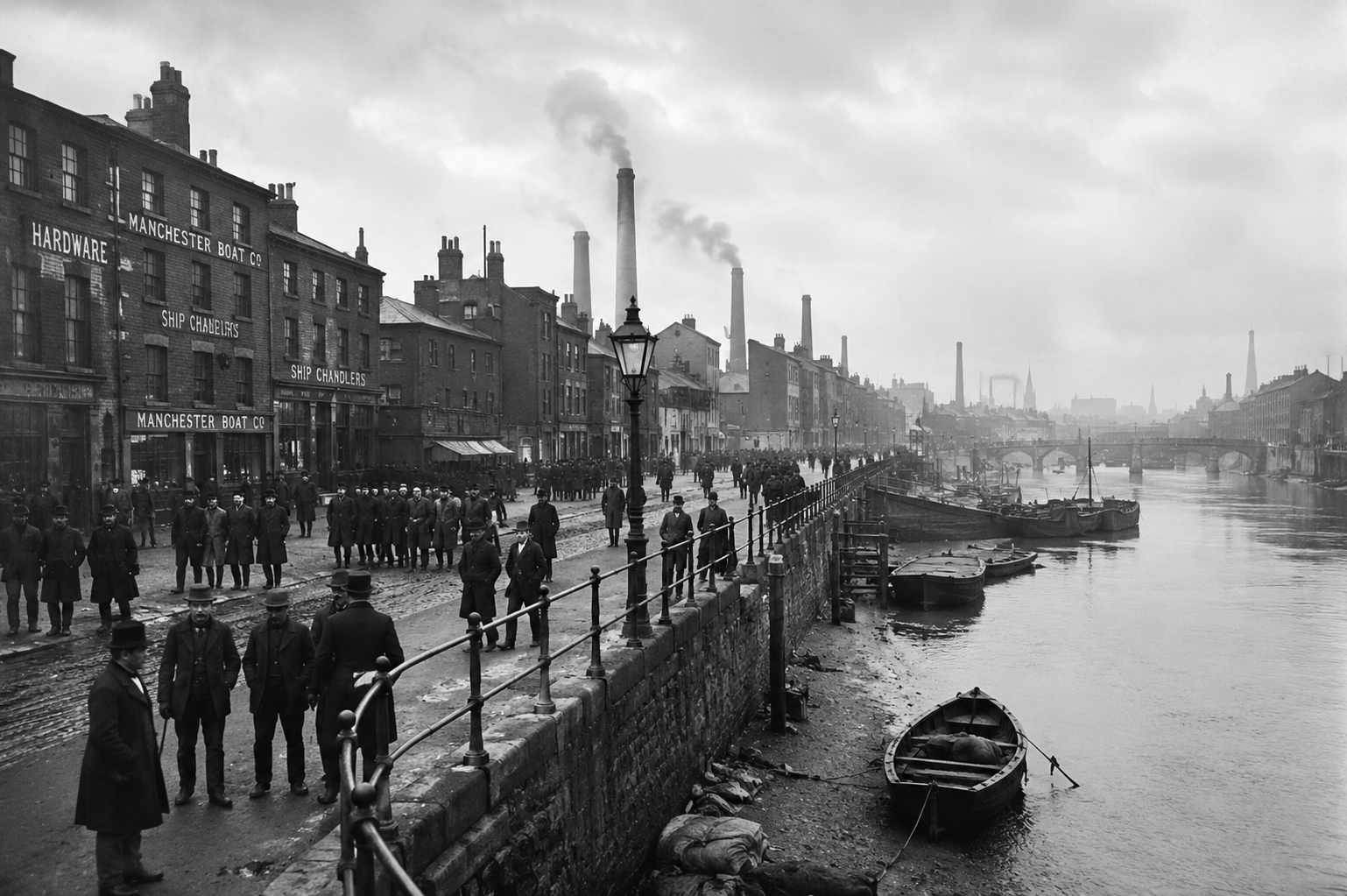
Historical fiction has long occupied a fascinating position within European literature. The genre allows writers not only to reconstruct the past, but also to interrogate it, challenge it, and reinterpret it through modern sensibilities. In recent years, many historical novels have leaned heavily into spectacle, mystery, or simplified nostalgia. Sabastian Gall’s Star Sky – A Macedonian Story, however, moves in a far more ambitious direction. The novel combines emotional intimacy with political turbulence, placing its characters inside a meticulously recreated nineteenth-century Britain that feels alive with social tension, industrial transformation, moral contradiction, and youthful idealism.
Although the title suggests a geographically distant or mythic narrative, the story itself unfolds primarily in England during the early 1850s, a period marked by the full force of the Industrial Revolution. Through Manchester, London, railway expansion, university culture, environmental unrest, and class conflict, Gall constructs a narrative world that is intellectually rich while remaining emotionally accessible.
What makes Star Sky – A Macedonian Story especially compelling is the author’s refusal to separate personal relationships from historical change. Romance, ambition, class anxiety, political activism, industrial greed, educational reform, and generational conflict all intersect naturally. The novel is not merely a love story, nor simply a social commentary. It is an expansive literary tapestry about people attempting to define themselves during one of the most transformative eras in British and European history.
A Richly Constructed Historical Setting
One of the most impressive achievements in Gall’s novel is the extraordinary depth of historical atmosphere. The Britain of 1852 does not feel like a decorative backdrop added for visual effect. Instead, the era becomes an active force shaping every conversation, opportunity, and conflict.
The novel’s Manchester sequences are particularly powerful. Gall presents the city not merely as an industrial centre, but as a living organism fuelled by smoke, machinery, labour, wealth, illness, and ambition. Readers can almost hear the relentless pounding of textile machinery and smell the polluted air surrounding the factories.
The descriptions of the Blackwell & Cartwright textile operation demonstrate remarkable literary maturity. Gall understands that industrialisation was simultaneously a source of progress and suffering. The factory owners view themselves as builders of prosperity and modern civilisation, while workers and students increasingly recognise the devastating human cost of unchecked industrial expansion.
This duality becomes central to the novel’s moral complexity.
The polluted Irk River serves as more than a plot device. It functions symbolically throughout the narrative as a representation of corrupted progress. Britain’s industrial success has poisoned not only water but also social trust, political ethics, and human relationships.
Gall’s attention to architectural and urban detail is equally noteworthy. The references to Euston Arch, King’s Cross Station, railway expansion, Victorian tea culture, university life, and the rapidly changing geography of industrial England all create a convincing sense of immersion.
Importantly, these historical details never feel forced. Many historical novels suffer from excessive exposition, where authors appear eager to demonstrate research rather than advance storytelling. Gall largely avoids this trap. The information emerges organically through character interactions, observations, newspapers, train journeys, and political discussions.
The result is a novel that feels authentic rather than performative.
The Industrial Revolution as Human Drama
One of the strongest literary qualities of Star Sky – A Macedonian Story is its understanding that history is ultimately about people rather than events.
The Industrial Revolution in Gall’s work is not reduced to statistics or broad historical summaries. Instead, readers witness how industrialisation transforms individual lives.
Workers fear unemployment.
Students debate morality.
Factory owners defend profit.
Women negotiate survival.
Young men dream about changing society.
Older elites fear instability.
This human-centred perspective gives the novel emotional weight.
The environmental protests surrounding the Blackwell & Cartwright factory form the political backbone of the story. Gall handles this conflict with impressive nuance. Derek Blackwell is not portrayed as a simplistic villain. He genuinely believes he is protecting economic stability and industrial success. Edmund Cartwright, meanwhile, recognises the ethical crisis but struggles against financial reality and generational power shifts.
The conversations between industrialists reveal one of the novel’s greatest strengths: ideological realism.
These characters sound like nineteenth-century men wrestling with modernity. Their dialogue reflects economic anxieties, class consciousness, imperial confidence, and fear of social unrest.
The debates surrounding pollution and worker resistance feel strikingly contemporary without becoming anachronistic. Gall understands that many modern political conflicts already existed in embryonic form during the Victorian era.
Questions concerning environmental destruction, corporate accountability, labour exploitation, public health, and political representation resonate strongly throughout the novel.
This gives the work unusual relevance.
Romance and Emotional Intimacy
Despite its broad political and historical scope, Star Sky – A Macedonian Story remains deeply invested in human relationships.
The romantic storylines provide emotional warmth within an otherwise turbulent social landscape.
Aries Kobber and Katie Stein represent one of the novel’s most emotionally engaging relationships. Their romance captures the impulsive intensity of young love while also reflecting broader questions about class, independence, and changing gender roles.
Katie is particularly interesting because she refuses passive femininity.
When Aries suggests traditional expectations about providing for her financially, Katie immediately pushes back against outdated assumptions. This moment reveals Gall’s awareness of shifting social attitudes during the nineteenth century.
Katie’s determination to work and maintain personal agency makes her feel refreshingly modern without breaking historical plausibility.
Their interactions also reveal Gall’s skill with tonal balance. Amid industrial unrest and political tension, the romantic scenes offer tenderness, humour, awkwardness, and youthful sincerity.
The early café encounter between Aries and Katie demonstrates this perfectly. Their playful exchange about a greeting kiss combines flirtation with emotional vulnerability.
Gall understands that believable romance often emerges through small conversational details rather than grand declarations.
Similarly compelling is Kevin O’Brien’s evolving relationship with Stephanie Eight.
Kevin stands out immediately as one of the novel’s most fascinating characters. As the first Black student at Owens College, he embodies both intellectual ambition and social isolation.
Gall deserves significant credit for integrating racial identity into the narrative with sensitivity and historical awareness.
Kevin’s presence highlights Britain’s imperial interconnectedness while also challenging simplistic assumptions about Victorian society.
His conversations with Stephanie reveal emotional hesitation, curiosity, admiration, and political awakening.
Stephanie herself becomes increasingly intriguing as the narrative develops.
At first glance, she appears to be a cheerful pub worker offering emotional comfort to exhausted students and workers. Gradually, however, readers discover her hidden role in producing protest materials and supporting resistance movements.
This duality makes her one of the novel’s most symbolically powerful figures.
She represents the hidden labour of political activism — the quiet individuals who sustain revolutionary movements behind the scenes.
Exceptional Dialogue and Character Voice
Dialogue is often one of the weakest elements in historical fiction. Many writers either modernise speech excessively or overwhelm readers with artificial archaic language.
Sabastian Gall navigates this challenge remarkably well.
The characters sound period-appropriate without becoming inaccessible.
William Kenton’s formal yet compassionate speech patterns beautifully capture educated Victorian professionalism. His conversations with Thomas Pickwick reveal intelligence, mentorship, and understated idealism.
Meanwhile, the younger characters speak more naturally and impulsively, reflecting generational differences.
Gall also demonstrates an excellent ear for social hierarchy.
Characters from different backgrounds speak differently without caricature.
Industrialists, students, workers, pub owners, and academics all possess distinct verbal rhythms.
This subtle variation strengthens immersion.
Thomas Pickwick emerges as a particularly effective audience surrogate. Through his eyes, readers experience railway expansion, architectural ambition, social mobility, and professional aspiration.
His relationship with William Kenton provides some of the novel’s most intellectually satisfying scenes.
Kenton functions almost as a philosophical guide within the story.
Unlike many authority figures in historical fiction, he values curiosity, intellectual independence, and social progress.
His statement regarding youthful rebellion being necessary for societal advancement reflects one of the novel’s central themes.
Gall appears deeply interested in the relationship between generational change and historical transformation.
Architecture, Railways, and Modernity
Few historical novels engage with infrastructure and engineering as effectively as Star Sky – A Macedonian Story.
Gall treats railways, stations, bridges, factories, and educational buildings not simply as settings, but as ideological symbols.
The railway sequences are especially memorable.
Thomas Pickwick’s train journey through industrial England captures the astonishing speed of nineteenth-century transformation.
Villages become cities.
Fields become railway hubs.
Traditional rhythms collapse beneath industrial acceleration.
Gall recognises the railway as one of the defining forces of modern consciousness.
The train compresses space, alters human perception of distance, and connects previously isolated communities.
The descriptions of Crewe, Rugby, Euston Station, and expanding industrial corridors reflect genuine historical understanding.
Architecture also plays a major thematic role.
William Kenton’s profession is symbolically important because architects literally shape the future.
Buildings in the novel represent permanence, ambition, civilisation, and memory.
Thomas becomes deeply moved while observing monumental structures like Euston Arch because he recognises architecture’s ability to outlive individuals.
Gall repeatedly contrasts constructive progress with destructive industrial excess.
Railways and universities can elevate society.
Factories can enrich society.
But without moral responsibility, industrial achievement becomes spiritually hollow.
This tension gives the novel philosophical depth.
Women in the Novel
One of the most impressive aspects of Gall’s writing is the complexity of his female characters.
Historical fiction sometimes reduces women to romantic accessories or symbolic moral guides.
Gall avoids this entirely.
Katie, Stephanie, Elizabeth Cartwright, and even peripheral female figures all possess agency, intelligence, and ideological perspectives.
Stephanie Eight may ultimately become the novel’s most compelling character.
Her public role as smiling pub hostess contrasts sharply with her private political activism.
The hidden basement printing operation evokes revolutionary literature traditions stretching from nineteenth-century socialism to underground resistance movements across Europe.
Stephanie understands that social change requires organisation, messaging, secrecy, and courage.
Her political intelligence exceeds that of many male characters.
Elizabeth Cartwright is equally fascinating.
Although married into industrial wealth, she demonstrates awareness of educational reform and social prestige.
Gall subtly portrays the complicated position of upper-class Victorian women — influential yet constrained, politically aware yet structurally excluded from formal power.
The “Woman in Black” protest speaker introduces another powerful feminine presence.
Her speech is one of the novel’s finest literary moments.
The rhetoric combines moral outrage with political sophistication.
She connects environmental devastation directly to political disenfranchisement.
The speech feels historically credible while simultaneously resonating with modern readers.
Its emotional power derives from restraint.
Rather than relying on melodrama, Gall allows the moral logic itself to generate intensity.
Political Consciousness and Moral Complexity
Perhaps the novel’s greatest achievement lies in its political sophistication.
Many contemporary historical novels flatten ideology into simplistic moral binaries.
Gall resists this temptation.
Even deeply flawed characters receive understandable motivations.
Derek Blackwell’s authoritarian instincts emerge from fear of instability and economic collapse.
Edmund Cartwright genuinely wishes to improve conditions but struggles against financial realities and institutional inertia.
Richard Walthamstaw balances idealism with political pragmatism.
Kevin and the student activists believe passionately in justice yet remain inexperienced.
No group possesses complete moral purity.
This ambiguity strengthens the novel enormously.
Gall portrays political awakening as gradual, messy, emotionally charged, and socially dangerous.
Characters evolve through conversation, observation, and personal relationships rather than dramatic ideological conversions.
The protests themselves are especially well written.
Gall captures the unpredictable emotional energy of collective action.
Crowds become living entities driven by hope, anger, fear, and solidarity.
The atmosphere surrounding the demonstrations feels authentic because Gall understands that political movements are sustained not only by ideology but also by friendship, romance, loneliness, humiliation, and shared suffering.
The environmental themes deserve special recognition.
Modern readers will immediately recognise parallels between the polluted Irk River and contemporary ecological crises.
Yet Gall avoids obvious moral preaching.
Instead, he demonstrates how environmental destruction intersects with class inequality.
The wealthy industrialists do not suffer directly from poisoned water.
Workers and the poor do.
This social imbalance becomes central to the novel’s critique of Victorian capitalism.
Literary Style and Narrative Structure
Stylistically, Star Sky – A Macedonian Story occupies an interesting space between classical Victorian realism and modern cinematic storytelling.
Gall frequently shifts perspective between locations and social classes.
Manchester pubs.
London offices.
Railway compartments.
University dormitories.
Aristocratic drawing rooms.
Public demonstrations.
These transitions create narrative momentum while expanding thematic scope.
The pacing remains surprisingly effective despite the novel’s density.
Gall balances quieter interpersonal scenes with larger political developments.
Moments of introspection are often followed by social confrontation or historical movement.
This rhythm prevents the narrative from stagnating.
The prose itself is elegant yet accessible.
Gall occasionally adopts period-influenced phrasing, particularly in formal dialogue, but generally prioritises readability.
Descriptions are vivid without becoming excessive.
Importantly, Gall understands atmosphere.
Rainfall, smoke, candlelight, train sounds, crowded pubs, industrial noise, and gas-lit streets create a sensory richness throughout the novel.
Manchester especially becomes almost mythic in its depiction — simultaneously beautiful, brutal, hopeful, and diseased.
The city functions as both setting and character.
Themes of Youth and Transformation
At its heart, Star Sky – A Macedonian Story is fundamentally about young people confronting a changing world.
Nearly every major character faces questions about identity, responsibility, and future direction.
Aries struggles between romance and ambition.
Kevin searches for belonging and moral purpose.
Thomas attempts to establish himself professionally while preserving intellectual independence.
Katie seeks autonomy within restrictive social expectations.
These individual journeys mirror broader historical transformation.
Victorian Britain itself appears uncertain about what kind of society it wishes to become.
Will industrial growth produce enlightenment or exploitation?
Will education expand freedom or reinforce hierarchy?
Will technological progress improve humanity or simply accelerate inequality?
Gall never offers simplistic answers.
Instead, he allows the characters to inhabit these tensions.
The novel’s educational settings reinforce this thematic focus.
Owens College symbolises intellectual possibility.
The institution welcomes ambitious young minds regardless of traditional religious restrictions.
Yet even education becomes politically contested once students begin questioning industrial power structures.
Gall portrays youth not as naive idealism alone, but as a historical force capable of reshaping society.
A Distinctive Contribution to Historical Fiction
What ultimately separates Star Sky – A Macedonian Story from more conventional historical novels is its breadth of ambition.
Sabastian Gall is not merely reconstructing Victorian England.
He is exploring how modern society itself emerged.
Industrial capitalism.
Environmental activism.
Mass education.
Urbanisation.
Railway modernity.
Labour resistance.
Political representation.
Gender negotiation.
Racial identity.
All these forces collide within the narrative.
Yet despite this complexity, the novel never loses emotional focus.
Readers remain invested because Gall grounds historical transformation in intimate human experiences.
Love affairs.
Professional anxieties.
Friendships.
Family conflict.
Loneliness.
Hope.
Fear.
These emotional realities prevent the novel from becoming overly academic.
There are echoes of Charles Dickens, Elizabeth Gaskell, Émile Zola, and even early Tolstoyan social realism within Gall’s approach.
However, the novel still maintains its own identity.
Gall’s voice feels modern enough to engage contemporary audiences while respecting nineteenth-century literary traditions.
Final Verdict
Star Sky – A Macedonian Story is an ambitious, intelligent, and emotionally resonant work of historical fiction.
Sabastian Gall demonstrates remarkable skill in combining industrial history, political consciousness, romance, architecture, environmental conflict, and social transformation into a coherent literary experience.
The novel’s greatest strength lies in its humanity.
Even amidst ideological battles and sweeping historical change, Gall never forgets the emotional lives of his characters.
Their relationships, vulnerabilities, ambitions, and fears remain central throughout.
The richly detailed Victorian setting, morally complex political debates, and nuanced characterisation elevate the novel beyond standard historical entertainment.
Readers interested in nineteenth-century Britain, industrial history, social justice, railway expansion, university culture, or literary realism will find much to admire.
At the same time, the emotional accessibility of the narrative ensures that the story never feels distant or overly intellectual.
Perhaps most impressively, the novel understands that history is not merely about kings, wars, or governments.
History is also about students sharing beers in crowded pubs.
Young lovers kissing in public gardens.
Workers fearing disease.
Architects imagining future cities.
Women secretly printing revolutionary pamphlets.
And ordinary people slowly discovering the courage to challenge systems larger than themselves.
In that sense, Star Sky – A Macedonian Story succeeds not only as historical fiction, but as a meditation on how societies evolve through the dreams, failures, and moral choices of individuals.
Sabastian Gall has crafted a novel that feels both classically inspired and strikingly contemporary.
It is a story about the nineteenth century, but it speaks powerfully to the twenty-first.
For readers seeking thoughtful literary historical fiction with emotional depth and political intelligence, Star Sky – A Macedonian Story is unquestionably worth reading.