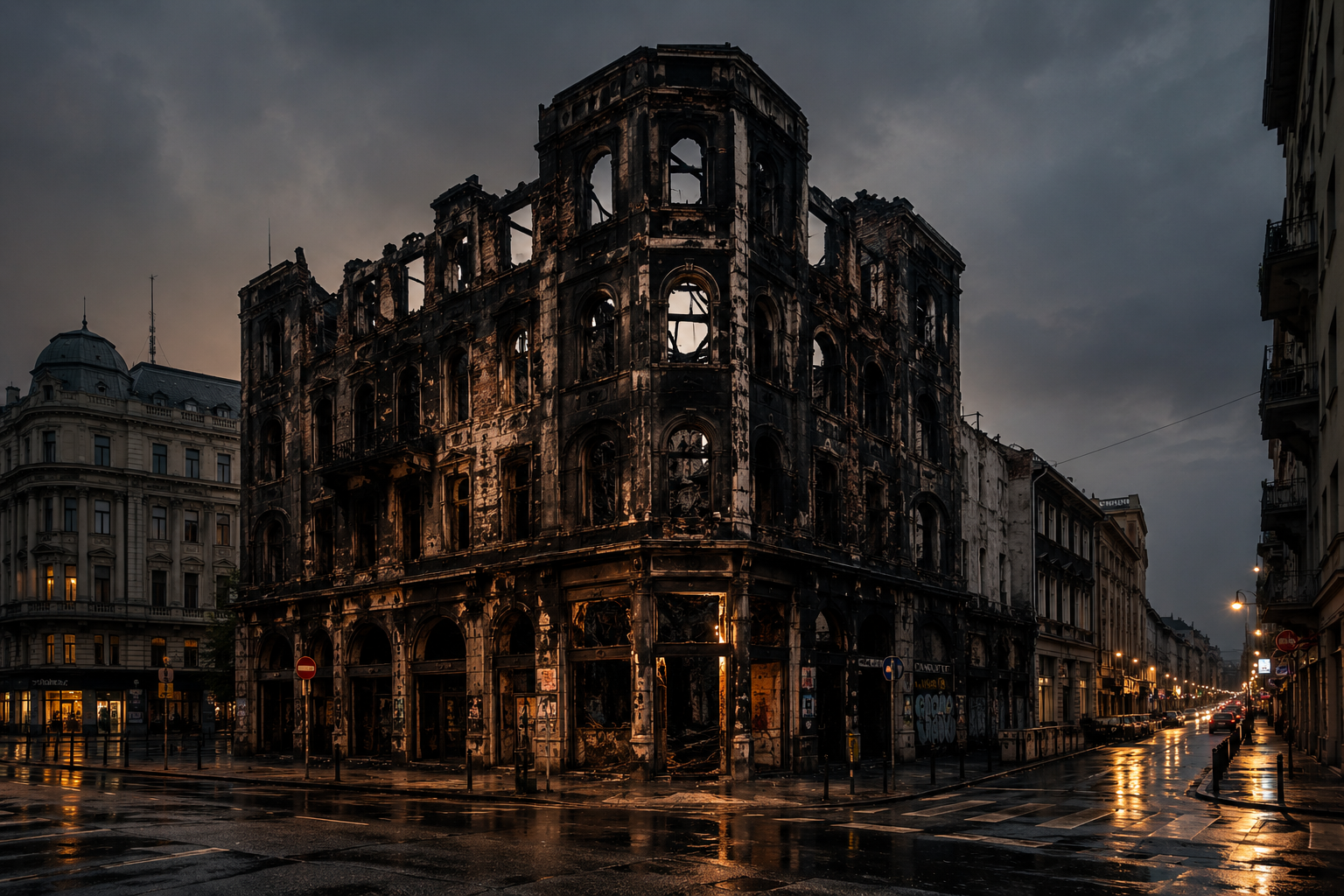
Modern horror fiction often struggles with one central problem: too much explanation. Creatures are over-described, mythologies become bloated, and fear disappears beneath endless exposition. Sabastian Gall’s The Fire Imp – The Glowing avoids that trap entirely. Instead of trying to explain every shadow, Gall embraces ambiguity, atmosphere, and psychological unease.
The result is one of the most unsettling urban horror novellas in recent years.
What makes the story even more fascinating is the fact that Gall reportedly dreamed the original concept almost exactly as it appears in the novella. The Fire Imp itself, the abandoned construction site, the strange rules surrounding the hauntings, and the suffocating atmosphere all emerged from a literal nightmare. That dream-origin gives the book an authenticity many horror stories fail to achieve.
Readers do not merely observe fear in The Glowing. They experience it.
A Horror Story Born From a Dream
Some horror novels feel carefully engineered. Others feel instinctive, almost accidental, as if the story existed before the author consciously understood it. The Fire Imp – The Glowing belongs firmly in the second category.
Gall captures the irrational emotional logic of nightmares with remarkable precision. Strange details appear with dreamlike intensity:
- the smell of smoke before the creature arrives,
- sudden bursts of unnatural heat,
- impossible movement in the corner of the eye,
- and the terrifying certainty that something is watching from the darkness.
None of these elements are overexplained. Instead, they accumulate gradually until the reader feels trapped inside the protagonist’s growing paranoia.
That restraint is one of the novella’s greatest strengths.
Budapest Becomes Part of the Horror
One reason The Glowing stands out from contemporary supernatural thrillers is its setting. Rather than using isolated cabins or gothic mansions, Gall roots the horror in modern Budapest.
The story begins after a concert, when two teenagers cut through an abandoned construction site near Nyugati tér — the former location of the old Centrum building. It feels like an ordinary decision young people would genuinely make after midnight.
That realism matters.
The city in The Glowing feels lived-in and authentic. Gall’s Budapest is cold, wet, sleepless, and emotionally exhausted. Neon reflections shimmer on rain-soaked pavement. Empty tram lines stretch into darkness. Underpasses echo with distant footsteps. Apartment windows glow above silent streets.
Instead of romanticising the city, Gall transforms it into an urban nightmare landscape.
The abandoned Centrum site becomes especially effective because it feels believable. Readers familiar with Budapest can easily imagine the legend spreading online or through whispered late-night conversations:
“Don’t go through the old Centrum lot after dark.”
That sense of urban folklore gives the novella tremendous power.
The Fire Imp Is a Brilliant Horror Creation
Modern horror desperately needs new monsters. Fortunately, Gall delivers one.
The Fire Imp is terrifying precisely because it remains partially unknowable. Small, ember-like, impossibly fast, and surrounded by the smell of burning air, the creature feels primal rather than cinematic. Gall wisely avoids overexposing it.
Many writers ruin their monsters by explaining too much. Here, the Fire Imp appears only in fragments:
- glowing eyes,
- rapid movement,
- scratching sounds,
- flickering shadows,
- and moments of unbearable stillness.
Its unpredictability creates lasting tension.
At times, the creature merely watches. In other scenes, it moves with horrifying speed. Occasionally, it vanishes before the protagonist fully processes what he saw. Because the novella never fully defines the Fire Imp’s limitations, the reader remains constantly uneasy.
The creature feels less like a conventional demon and more like an ancient force attached to forgotten places.
The “Three Visitations” Rule Creates Constant Dread
The mythology behind the Fire Imp is deceptively simple.
After a triggering event, the creature appears three times:
- The first haunting serves as a warning.
- The second destabilises the victim psychologically.
- The third becomes potentially fatal.
This structure works brilliantly because it transforms the story into a countdown.
Once the first visitation begins, both the protagonist and the reader understand that something worse is coming. Every scene becomes charged with anticipation. Every flickering light or unexplained sound carries emotional weight.
Gall handles escalation masterfully.
Instead of relying on endless jump scares, he builds dread slowly and methodically. The novella becomes more oppressive with each chapter. By the final sections, the atmosphere feels almost unbearable.
The structure recalls films like It Follows or Final Destination, yet The Glowing ultimately feels far more intimate and folkloric.
Isolation Becomes the Real Horror
One of the novella’s most disturbing concepts is that only the affected victim can see the Fire Imp.
This single narrative choice elevates the story enormously.
Once the protagonist begins seeing the creature, reality itself becomes unstable. Friends cannot confirm what he sees. Other people continue living normally while his psychological state collapses around him.
Gall explores this isolation with remarkable subtlety.
At first, the protagonist questions his own sanity. Later, paranoia takes over completely. Every dark hallway becomes threatening. Every sudden noise feels loaded with meaning. Because no one else can verify the Fire Imp’s existence, the protagonist becomes trapped inside a private nightmare.
That emotional isolation makes the horror deeply human.
The novella stops being merely about a monster and becomes a story about what happens when someone experiences something impossible completely alone.
The Dream Logic Makes the Story Feel Authentic
Many horror novels imitate nightmares. Very few genuinely feel dreamlike.
Gall succeeds because he preserves the irrational emotional texture of dreams instead of forcing strict logical explanations onto every event. The novella often moves according to emotional instinct rather than conventional storytelling mechanics.
That quality gives the book extraordinary atmosphere.
Readers never feel fully safe or grounded. Familiar locations gradually become uncanny. Ordinary city spaces start feeling contaminated by hidden meaning. The Fire Imp itself behaves according to rules that seem ancient but never fully understandable.
Dreams often terrify people because they distort certainty itself. Gall understands that perfectly.
As a result, The Glowing feels psychologically real even during its most supernatural moments.
Atmosphere Matters More Than Gore
One of the novella’s smartest creative decisions is its focus on psychological dread over graphic violence.
Readers expecting nonstop action or splatter-heavy horror may initially find the pacing slower than expected. However, the deliberate pacing is exactly what makes the story effective.
Gall understands the power of silence.
Some of the book’s most frightening moments involve almost nothing happening externally:
- a hallway remaining dark too long,
- scratching sounds behind walls,
- unexplained heat in an empty room,
- or the sensation that someone is standing just outside the field of vision.
These moments linger far longer than cheap shocks.
The prose itself supports the atmosphere beautifully. Gall writes cinematically without becoming self-indulgent. His imagery is sharp, visual, and memorable:
- orange reflections in rainwater,
- dark stairwells humming with electrical silence,
- smoke drifting through empty streets,
- and ember-like light flickering against wet concrete.
Every detail contributes to the oppressive mood.
The Fire Imp Feels Like Modern Urban Folklore
Perhaps the novella’s greatest accomplishment is how believable its mythology feels.
The Fire Imp already resembles an authentic urban legend rather than a fictional invention. Readers can easily imagine hearing rumours about the creature:
- from late-night couriers,
- from teenagers after concerts,
- from exhausted tram passengers,
- or from strangers smoking outside apartment buildings at 2 a.m.
Gall taps into something ancient here.
Folklore has always evolved alongside cities. In centuries past, people feared spirits in forests or abandoned villages. Today, those fears naturally migrate into construction sites, underpasses, empty apartment blocks, and forgotten urban spaces.
The Glowing understands modern city anxiety perfectly.
The novella suggests that horror no longer lives in castles or graveyards. It waits beneath neon lights, behind locked fences, and in the silent corners of familiar streets.
The Emotional Core Beneath the Horror
Beneath the supernatural elements lies a surprisingly emotional story about fear, vulnerability, and psychological collapse.
The Fire Imp does not simply attack people physically. Instead, it slowly dismantles their sense of safety and certainty. That emotional approach makes the novella resonate beyond its horror premise.
Gall also avoids turning the story into a simple metaphor.
The creature remains genuinely supernatural, yet it simultaneously reflects very human fears:
- anxiety,
- paranoia,
- guilt,
- emotional isolation,
- and the terror of experiencing something no one else understands.
That layered approach gives the novella depth many horror stories lack.
The protagonist’s fear feels painfully believable because Gall never portrays him as a typical horror hero. He reacts like a real person trapped inside an impossible situation.
Sabastian Gall Has Created Something Special
Independent horror fiction is crowded with derivative supernatural thrillers, but The Fire Imp – The Glowing genuinely feels original.
Part of that originality comes from its setting. Part comes from the dream-inspired concept. Most importantly, however, it comes from Gall’s understanding of fear itself.
The novella does not try to overwhelm readers with complicated mythology or excessive violence. Instead, it focuses on atmosphere, psychological instability, and the terrifying possibility that certain places remember things humanity has forgotten.
The Fire Imp itself deserves recognition as one of the strongest modern horror concepts in recent indie fiction. The creature feels timeless while remaining fresh. It combines elements of European folklore, urban legend, nightmare imagery, and psychological horror into something uniquely disturbing.
Most importantly, the fear lingers after the final page.
Readers may find themselves thinking differently about abandoned construction sites, dark stairwells, or empty streets after midnight. They may imagine fleeting movement in the corner of their eye. They may remember the novella while smelling smoke unexpectedly in an otherwise ordinary room.
That lingering unease is the hallmark of successful horror.
Sabastian Gall has not merely written a supernatural thriller. He has created the foundation for a modern urban legend — one born from a nightmare and transformed into a deeply atmospheric piece of psychological horror fiction.
The Fire Imp – The Glowing proves that the most frightening stories are not always invented.
Sometimes they are remembered from dreams.